|

LZX - Der Amiga-Archiver
History & Downloads
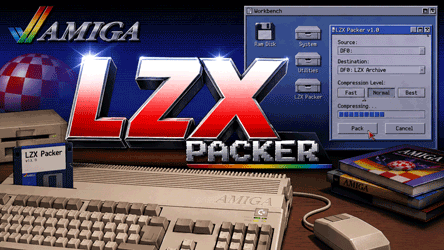
Bild KI-generiert
LZX is a brand new data compression program developed on and for the Amiga, sporting mind-blowing compression rates, and brain-staggering speed.
LZX is a co-development between Jonathan Forbes (author of the LZ and LX archivers, as well as the commercial Bulletin Board Software package Xenolink), and Tomi Poutanen .
LZX uses compression technology that is absolutely state of the art, and offers a compression/performance ratio superior to that of all other programs for the Amiga, as well as to all programs for MS-DOS.
December 12, 1997
======================================
Bruce Goodman added generic keyfile and lzxkeyfile.readme to archive and re-uploaded to Aminet, as authorized by Jonathan Forbes.
|
Es gibt zwei unabhängige Fixes für den LZX-1.21R1-Y2K-Bug:
Dr.Titus' Patch & Mikolaj Calusinskis Patch
Ein Test (dokumentiert auf der LZX-Seite von Xav Productions) hat archive mit allen drei Versionen (Original, Titus, Mikolaj) erstellt und dann mit verschiedenen Tools wieder entpackt. Ergebnis:
Archive, die mit Titus' Version erstellt wurden, liefern korrekte Datumsangaben nach 2000 nur, wenn man auch Titus' eigene Version zum Entpacken benutzt.
Mit Mikolajs Patch, dem Original-LZX, unlzx, unlzx2 oder xadmaster.library entpackt, kommen bei Titus-Archiven wieder falsche Datumsangaben (nach 2000) raus.
Umgekehrt lassen sich Mikolaj-Archive korrekt nur mit Mikolajs eigenem Patch oder mit xadmaster.library entpacken und nicht mit Titus' Version.
Ein Vergleich der Binärdateien zeigte außerdem: Titus' Patch ist auf Byte-Ebene identisch mit dem Original-LZX (also ein sehr minimaler, kompatibler Fix), während Mikolajs Patch echte Unterschiede aufweist und daher auch die Inkompatibilität zu xadmaster.
Kurz gesagt: Das "Datumsproblem" taucht wieder auf, wenn man ein mit Titus' Fix gepacktes Archiv mit einem anderen Tool als Titus' eigenem entpackt und nicht weil der Fix selbst fehlerhaft ist, sondern weil die beiden Patches unterschiedliche, nicht kompatible Lösungsansätze verfolgen.
|
Amigashell Optionen:
LZX 1.21 (Registered) Archive/Extract utility - 68040/68060 Version.
Copyright © 1995 Data Compression Technologies.  All rights reserved.
Registered to the Amiga community for non-commercial use.

Usage: LZX [-<options>] <command> <archive> [<file>...] [<destdir>]

<command>:
  a  Add file(s) to archive               p    Print file(s) to stdout
  af Add file(s) to archive, faster       r    Replace file(s) in archive
  c  Concatenate archive(s)               t    Test file(s) in archive
  d  Delete file(s) from archive          u    Update file(s) in archive
  e  Extract file(s)                      v[n] List file(s) [verbose]
  f  Freshen file(s) in archive           x    Extract file(s) with full path
  l  List file(s) [terse]

<options>:
 -a (ax) Preserve file attributes        -q (ax) Configure console output
 -bi(ax) Set input buffer size (Kb)      -r (a ) Recurse into subdirectories
 -bo(ax) Set output buffer size (Kb)     -R (ax) Collect archives recursively
 -c (ax) Confirm files/archives          -s (a ) Add only files with no A bit
 -C ( x) Clear arc (A) bit on extract    -S (a ) Set A bit on added files
 -e (a ) Archive empty directories       -u (ax) Make file names upper case
 -E ( x) Touch extracted files           -U (ax) Set update rate (Kb)
 -f (ax) Ignore filenotes                -w (a ) Set work directory
 -F (ax) Fast progress display           -x (a ) Preserve path names
 -k ( x) Keep partial extractions        -X (ax) Control .LZX suffixing
 -l (ax) Make file names lower case      -y (a ) Store files with ratio >= x%
 -m (ax) Disable interactivity           -Y (a ) Compress archives
 -M (a ) Set merge group size limits     -0 (a ) Store files
 -o (ax) On or after date (yyyy/mm/dd)   -1 (a ) Fast compression
 -O (ax) On or before date (yyyy/mm/dd)  -2 (a ) Default compression
 -p (ax) Pause after loading             -3 (a ) More compression
 -P (ax) Set task priority               -9 (a ) Maximum compression
 -Qf(a ) Faster compression (more RAM)   -- (ax) Stop further option parsing
|
|
Über LZX:
Jonathan Forbes und Tomi Poutanen entwickelten LZX 1995 als Studenten der Computer Engineering an der University of Waterloo, Kanada, unter der gemeinsamen Marke Data Compression Technologies.
Die Kompressionsforschung erfolgte gemeinsam in portablem C, danach übernahm Forbes die Amiga-Version und Poutanen die parallel entwickelte PC-Version.
Forbes hatte zuvor bereits die Amiga-Archiver LZ und LX sowie die BBS-Software Xenolink geschrieben. 1996 wechselte Forbes zu Microsoft, wo der LZX-Algorithmus ins Cabinet-Format (CAB) und später in CHM, LIT und weitere Formate einfloss.
Poutanen gründete während des Studiums die Firma, die die Technologie an Microsoft verkaufte, und machte danach Karriere bei Yahoo sowie als Gründer mehrerer KI-Startups.
|
|
|